In December 2024, a fire broke out at a film set in Yeoncheon County, South Korea. In under two hours, firefighters had it under control — but not before a 3,655-square-meter building and all the lighting equipment inside were destroyed. No one was hurt. The show being filmed there hadn’t even been named yet.
That production was Netflix’s The East Palace (동궁, “Donggung”).
A year and a half later, on July 17, 2026, it finally premiered — and it’s since become one of the most talked-about Korean releases of the year, with reviewers comparing it to Kingdom, The Witcher, and even Stranger Things.
If you’re a K-drama fan wondering whether this one’s worth your time (short answer: probably yes, especially if creepy palace corridors and cursed bloodlines are your thing), this post is your no-spoiler starting point — plus five Korean words you’ll hear constantly if you watch it.
If you’re looking for a quick The East Palace kdrama review before diving in, here’s the spoiler-free breakdown.
What’s “The East Palace” actually about?
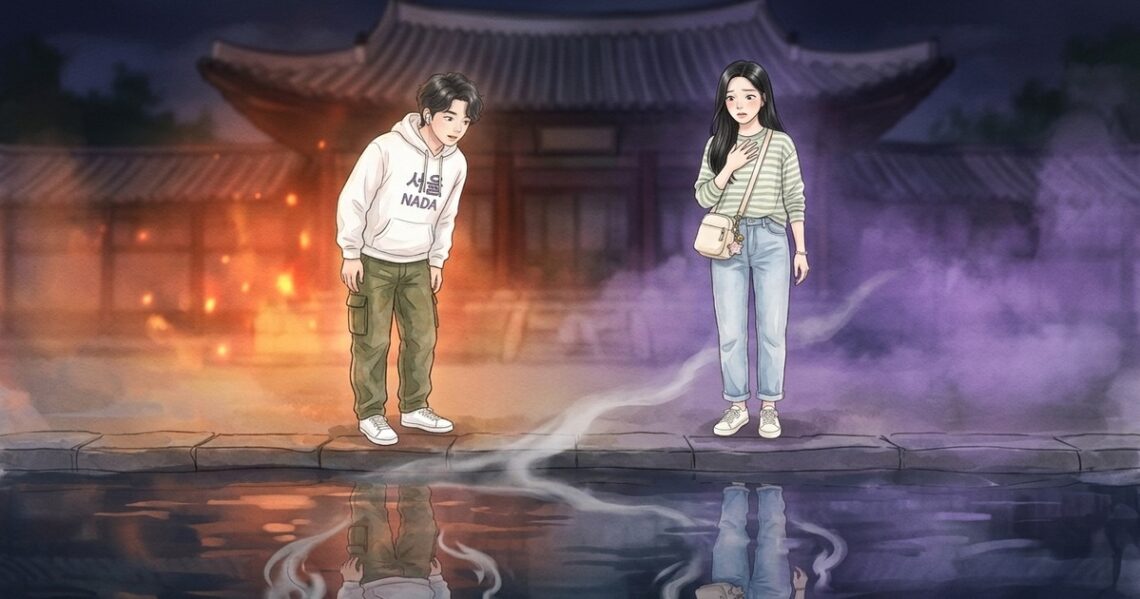
Set in the Joseon dynasty, the story follows Gu-cheon, a man who can cross between the human world and the world of spirits, and Saeng-gang, a court lady who can hear ghosts. The king’s sons — the crown princes — keep dying, one after another. Desperate, the king summons the two of them to find out what’s cursing the palace before his entire bloodline is wiped out.
It stars Nam Joo-hyuk — making this highly anticipated new drama of 2026 his first project since finishing military service — along with Roh Yoon-seo, and Cho Seung-woo, in his first time leading a streaming original.
Early English-language reviews have been largely positive: several praised the show’s atmosphere and visual craft, though a few noted the pacing slows down in places. If you liked the folklore angle in KPop Demon Hunters or the political dread of Kingdom, this is aimed squarely at you.
5 Korean words you’ll need
Historical K-dramas use a whole vocabulary set you basically never hear in a modern-day drama. Here are five you’ll run into constantly in The East Palace — with a note on whether they’re still used in everyday Korean today.
| Korean | Romanization | Meaning | Still used today? |
|---|---|---|---|
| 전하 | jeon-ha | “Your Majesty” (for the King) | ❌ Only in historical contexts |
| 저하 | jeo-ha | “Your Highness” (for the Crown Prince) | ❌ Only in historical contexts |
| 귀신 | gwi-sin | Ghost / spirit | ✅ Yes — often used casually, even jokingly |
| 저주 | jeo-ju | Curse | ✅ Yes — Koreans still say a sports team or a project is “cursed” |
| 무당 | mu-dang | Shaman | ✅ Yes — real shamans in Korea are still called this today |
“Your Majesty” (for the King)
❌ Only in historical contexts
“Your Highness” (for the Crown Prince)
❌ Only in historical contexts
Ghost / spirit
✅ Yes — often used casually, even jokingly
Curse
✅ Yes — Koreans still say a sports team or a project is “cursed”
Shaman
✅ Yes — real shamans in Korea are still called this today
The gap between column 3 and column 4 is basically the whole appeal of watching historical dramas as a language learner — you get to hear how differently Korean sounded just a couple hundred years ago, right next to words that haven’t changed at all.
Quick check
👉 Click the answer you think is correct
Q1. Which word would you use to describe a real fortune teller you might visit in modern Seoul?
A) 저하 B) 무당 C) 전하
✅ Answer: B) 무당 — real shamans in Korea today are still called this.
Q2. True or false: Koreans still casually say something is “저주받았다” (cursed) today, the same way English speakers say a project is “jinxed.”
True / False
✅ Answer: True — 저주 is one of the words on this list that survived into modern casual Korean.
That’s the setup — no major spoilers past what the trailer already shows. In the next post, we’ll get into the show’s shamanism angle in more depth, including a couple of ghost-related words that don’t translate cleanly into English at all.
Currently streaming on Netflix, worldwide.